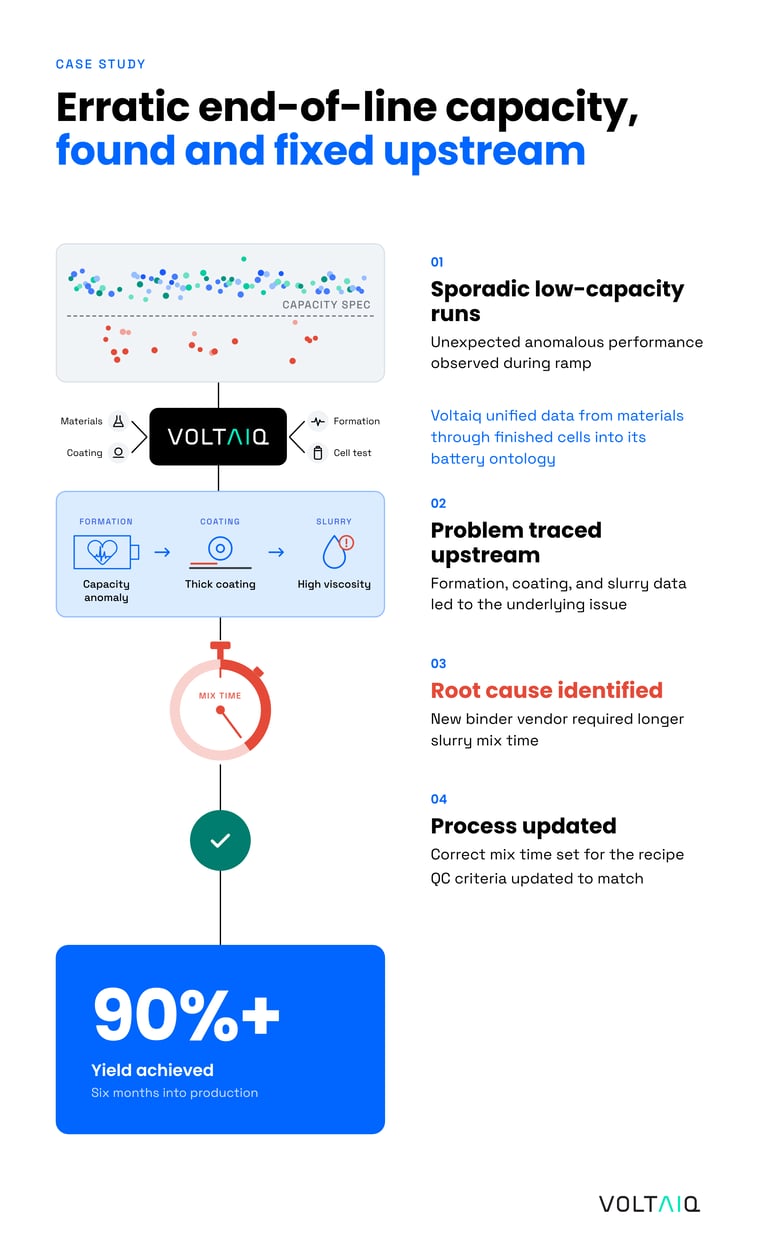









During production ramp a battery company was seeing inconsistent cell capacity at formation.
Using Voltaiq’s battery data ontology, the team traced low-capacity cells back to an upstream slurry issue.
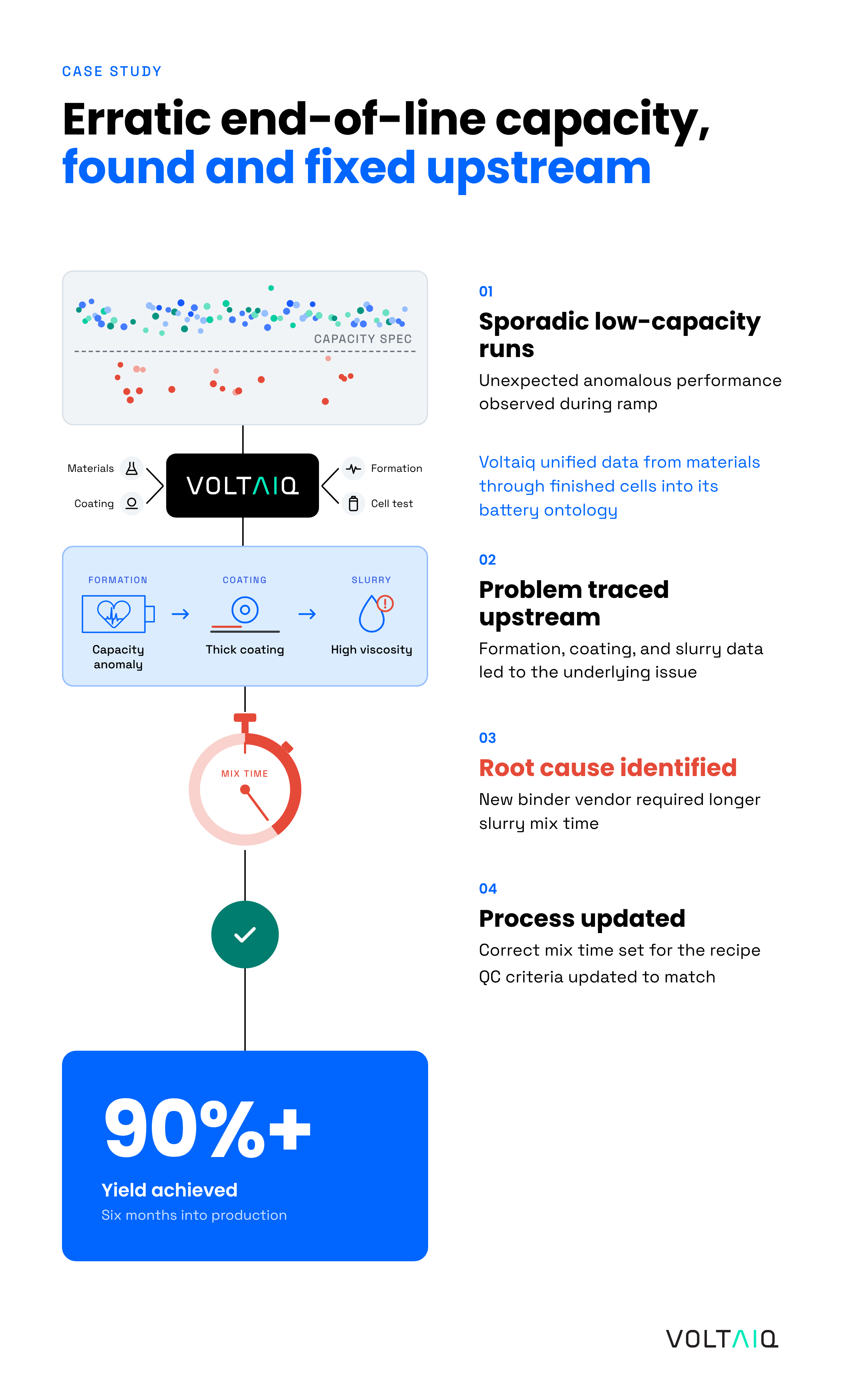
During production ramp, a battery manufacturer observed fluctuating cell capacity in Voltaiq's end-of-line (EOL) dashboard.
At this stage of manufacturing, a bad run can have dozens of potential causes. The Voltaiq team analyzed the affected cells and found that low capacity correlated with higher mean charge potential during the first formation cycle.
Using Voltaiq’s battery data ontology, the team traced that signal upstream across previously disconnected manufacturing data — from formation to electrode coating and ultimately slurry preparation.
It turned out that the affected cells were produced with an unusually thick cathode coating.
That finding led the investigation to another step upstream. The cathode slurry had not been mixed long enough, resulting in higher viscosity and ultimately a thicker coating. The issue stemmed from transitioning to a new vendor for their binder material.
The manufacturer updated its process manuals and inline quality-control practices to ensure the correct slurry mixing time for the recipe in question.
Six months into production, the manufacturer achieved 90%+ yield.